
Word-of-mouth referrals have historically been the most effective and desired marketing tool, as their occurrence within trusted relationships of families and friends lend credibility and esteem to brands. However, social media has launched referral marketing to a new level of opportunity.
Social Media: Changing the Way We Communicate
Social media has irrevocably changed the landscape of communication. People are connected in real-time via online communities where they can share thoughts, personal information, experiences, and referrals with a wide network of their peers on Instagram, Facebook, Twitter, Snapchat, TikTok, and more. Not only are we seeing an increase in word-of-mouth referrals, but we’re also seeing a surge in influencer marketing. Users with a high following are partnering with brands to help promote their products to impressionable followers. This provides significant influence to individual voices in the marketplace – and has a major effect on how businesses should market, communicate with prospects and customers, manage their public images, and improve their products and services.
Companies must adopt the peer-to-peer communication style of social media and focus on the needs and interests of their customers (rather than their own) to be successful marketers in this medium. By delivering regular content of customer interest and special benefits – as well as being an active ‘listener’ of fans and followers – businesses will enjoy a growing social media following that will deliver positive commentary, increased web traffic, and both on and offline referrals.
Build a Social Media Strategy
Sporadic postings to Facebook, Twitter, and Instagram accounts seem disjointed and disorganized. The most effective social media marketing approach is to carefully outline communications with a social media marketing plan. A well-designed strategy includes goals, budget guidelines, competitive research, strategy, and a content calendar. Having a social media marketing plan in place is also essential for measurement. With regular monitoring of the number of followers and quality of interactions, periodic reevaluations of strategies outlined in the plan can be adjusted accordingly.
Using a comprehensive social media marketing plan as a blueprint, increasing leads, referrals, and web site traffic can be accomplished by strategically participating in a variety of social media networks. There are thousands of them out there, but it is critical to select a handful that best reach your customers and target market(s). Typically, the most popular sites – Facebook, Twitter, Instagram, and even TikTok – are great starting points.
Communicate with Consumers
Be sure to communicate with customers and prospects via each social media account in a conversational, value-added fashion that isn’t always about your business. Include calls to action in your postings and web links to increase the probability they’ll be reposted – and answer customer questions and complaints in a timely fashion. Try to flex your creative muscle and design mini-campaigns that offer incentives, like rewards or contests for new ideas, customer-produced videos about your brand, and survey participation. The ultimate goal is consistent engagement with your brand followers.
In addition, a social media policy should be developed to define acceptable online communication practices for staff members who create content. This will ensure compliance with branding guidelines and will serve to prevent conflicts.
If you need assistance in creating a meaningful social media strategy that can directly boost web traffic and generate leads, contact Millennium’s social media team.
About Millennium Agency
Millennium Agency is a nationally recognized, top woman led B2B branding, positioning, and digital marketing firm who knows how to create value that emotionally influences your customer’s buying decision, giving you the competitive advantage. As your trusted partner in B2B software technology and manufacturing, we provide the branding and positioning framework that make an impact – so you can focus on what you do best – run your business successfully. With offices in Boston and New Hampshire, and a worldwide presence, the professionals at Millennium Agency would like to learn more about your business. Visit www.mill.agency or book time here.
Every business owner wants to build an interactive, customer friendly website. But how can you ensure prospective and existing clients find your site before landing on the home page of a competitor? The answer is search engine optimization (SEO).
It is a known fact that the majority of web users only click on links provided on the first page – and usually just on the first few links at the top of search engine results. Also, many users believe the organic search results on the first page are more reliable than paid ads. Focusing on SEO can markedly improve your website’s performance by increasing its rank in search engine results pages, effectively expanding the number of visitors to your site.
How to Improve SEO
Improving your site’s search engine rankings can be achieved with some simple changes. Think about the keywords that the majority of prospects in your market would enter when searching for your business. Google Ads has a keyword tool that can assist you in discovering popular search terms in your business’ area. Integrate those keywords into your site’s content, but be careful not to “keyword stuff”. With the increasing growth of digitization, Google has gotten smarter. If you choose to enter keywords in places that don’t make sense, your website could be considered spam – driving prospective customers away. Strategically place keywords into your site’s copy where it makes sense.
Keywords should also be linked to external sites or other pages on your site so that they become indexed by search engines. It is more beneficial to your site’s rankings to link keywords rather than linking non-descript phrases, like “Click here for more.”
Where to Put Keywords
Keywords should be incorporated into your site’s URL address, page titles, photo captions, and blog posts. Another effort to embrace is linking your site to top industry-related and trusted sites and requesting reciprocal links from them. Additionally, with social media’s popularity, linking to your site through your interactions and posts via Facebook, Twitter, LinkedIn, and Instagram will prove to be a rankings booster.
The effectiveness of your SEO strategies can be easily tracked and measured by periodic test searches for your keywords in major search engines. If you don’t have the time or skills to tackle SEO on your own, but want to improve your site’s rankings – Millennium Agency can design and manage an SEO plan that will bolster your online presence and bring in those coveted leads
About Millennium Agency
Millennium Agency is a national, award-winning, digital, creative, content/PR, and video marketing firm. With offices in Boston and New Hampshire, our team unites creative branding and data analytics to accelerate our clients’ growth, while combining our clients’ vision with our marketing expertise to increase sales opportunities and drive brand success. From video advertising and web design to social media and PR, Millennium can guide your marketing efforts every step of the way. Contact the professionals at Millennium Agency to learn more!
Sparking up interest for your cannabis brand can be challenging. With fierce competition and so many rules and regulations to keep track of, your brand can easily get swallowed up. Adapting to your consumers’ needs and creating content that draws in new audiences can seem like an impossible job, but with some help from us, those challenges can be put to bed.
- Blazing Brand Strategy
As you would with any marketing campaign, having a strong brand strategy is essential. You can’t market your products if you don’t know the core values that drive your company to success. Start by defining your company values. Then identify the problems you want to solve for your consumers, and work on communicating your message on various platforms.
- A Smoking Social Media Campaign
Social media is your best friend when it comes to marketing cannabis effectively to your audience. The images that can be curated from your product line(s) and displayed on Instagram are unmatched. As Instagram is very image-centered, it’s essential to put your best greens forward. Behind-the-scenes footage of products and your store can also create a feeling of transparency to your business, a trait Millennials and Gen Z value in their brands. Additionally, one of your top goals when marketing cannabis should be to educate not sell, but what does this look like in terms of social media? You can include recent and relevant industry news, educational graphics and links to recent studies to educate your audience and get them interested in the industry.
- Weeding through Websites
You may feel nervous about what you can post on traditional social media platforms, but there are websites out there specifically for cannabis brands to show off. Leafwire, Mjlink and Weedable are a few of the platforms that stand out to us. Connecting with other cannabis brands or wholesalers is made simpler with these platforms and you know your audience is already there looking for a brand like yours. Just create some content to draw in the customers.
- Captivating Cannabis Content
Now that we’ve established where the best places to market your content are, it’s time to focus on the content itself. As we mentioned above, one of your top goals is to educate your audience instead of trying to sell to them. This can be done with blog posts, case studies, eBooks, white papers, podcasts, webinars and more. All of which our team of experts at Cannabis Brands can handle for you if you don’t know where to begin!
- Mary Jane Media Coverage
Getting the word out there is especially critical for cannabis companies because the industry is still in the early stages with lots of fierce competition. Writing media pitches to news outlets could be the best way for your company to get noticed. Try outlets like Cannabis Business Times or Marijuana Venture as these are geared specifically to the cannabis industry.
Marketing in the cannabis industry is very challenging. Constantly trying to stay on top of changing rules and regulations while creating meaningful content to combat your competitors is a lot to handle. However, we can help with the content to alleviate some of that stress, contact our team of experts at our sub brand, Cannabis Brands!
About Millennium Agency
Millennium Agency is a national, award-winning, digital, creative, content/PR, and video marketing firm. With offices in Boston and New Hampshire, our team unites creative branding and data analytics to accelerate our clients’ growth, while combining our clients’ vision with our marketing expertise to increase sales opportunities and drive brand success. From video advertising and web design to social media and PR, Millennium can guide your marketing efforts every step of the way. Contact the professionals at Millennium Agency to learn more!
A way to captivate prospective customers, build engagement and trust – video advertisements do it all. Sticking to just still images in your media campaign can mean that prospective customers just look past your business entirely. About 45% of people watch more than one hour of Facebook or YouTube videos a week – target that 45% with video ads!
Here’s what else video ads can do:
Get Your Point Across
Video advertisements allow you to convey more information to your audience than still images. This information will also be more easily absorbed, and your message will get across more quickly than if you were to add lots of copy to a still image – where you’re more likely to lose your audience’s interest. Video ads allow more information to be conveyed in an effective and efficient manner.
Increase Engagement
It’s probably not too surprising that video ads receive more engagement than image ads alone, but it’s still worth mentioning. Your prospective customers are more likely to stop scrolling when they come across a moving video ad than a simple picture. Since these kinds of ads get noticed more, it increases their engagement. Pro tip: add a call-to-action at the end of the video so your prospective customers know just what to do!
Building Trust
As we continue to move into targeting more Millennials and Gen Z – there are certain practices that bode well with these generations. Millennials and Gen Z look for authenticity and transparency when choosing their favorite brands. They want a business that they know, like and trust. Video ad campaigns allow a more personalized platform to educate your business’s target audience on what you do and who you are. Video ads allow for a more authentic connection to be built in a shorter amount of time and can help showcase your brand’s unique personality.
Get Ahead of the Competition
Prospective customers want to know what makes you different from the competition – with video ads you can stand out. By creating high-quality video ads, you will significantly differentiate your brand from your competitors. Video creation, production and execution takes a long time and a lot of work so many brands opt out of it. However, video ads are a growing trend so get ahead now!
The Perfect Blend of Videos and Images
Both images and video ads, if executed well, can coexist in the same platform and generate high-quality leads. Since video ads take longer to execute than still images, plan ahead about what you want to accomplish and when you want to advertise. Let the still image advertisements fill in around your video.
If you’re interested in creating video ads for your business but don’t know where to begin – contact us today and we’ll help you get started. Our team of marketing experts can help your brand develop, create, and execute an effective video advertisement.
About Millennium Agency
Millennium Agency is a national, award-winning, digital, creative, content/PR, and video marketing firm. With offices in Boston and New Hampshire, our team unites creative branding and data analytics to accelerate our clients’ growth, while combining our clients’ vision with our marketing expertise to increase sales opportunities and drive brand success. From video advertising and web design to social media and PR, Millennium can guide your marketing efforts every step of the way. Contact the professionals at Millennium Agency to learn more!
You may use social media in your regular, everyday life. Whether you’re posting your latest food creation or quarantine activity, social media is there to capture it all. When it comes to translating that to your business, however, it can be trickier to know where to start and how to be successful. You market your everyday life on Facebook and Twitter, why not market your business too.
Here are five tips on building your social media marketing strategy for a successful campaign.
- Set Clear Goals
This could be generating leads and sales, increasing brand awareness, increase community engagement, increase web traffic or several other qualitative and quantitative goals that you wish to reach in your campaign. Setting clear goals helps build a roadmap for the rest of your social media marketing. It’s also important to communicate your goals, once they’ve been established, to your team so that everyone will be able to help effectively and efficiently.
- Know Your Audience
Chances are you have established your target audience and market in the branding stage of your business. You know the key demographics of your target audience and have gotten a good idea of how to tailor your content to them but knowing which social media platform your audience frequents can help boost your engagement. Facebook and YouTube are prime places for ads because they have high-earning user bases. Whereas the majority of millennials and Gen Z are on Instagram where they get eye-popping visuals and short captions. Women outnumber men on Pinterest, and LinkedIn’s users are well-educated and prefer industry-specific content. With this information and your own research of your target audience, you will be able to find the ideal spot to market in.
- Create Engaging Content
Based on the goals you’ve set, your brand identity and the products or services you offer, you should have a pretty good idea of what kind of content to publish. But how can you make it engaging for your audience? Including eye-catching or interesting images in your posts can help grab attention. Also, never pass up the opportunity to get feedback from your community. Ask questions, create polls, encourage comments, all of these will drive up your user engagement. If you’re still struggling with creating impactful social media content, our team of specialists is here to help.
- Timeliness is Important
Finding the best times to post on social media can be a little complicated. A good rule of thumb is to post when your brand can respond or communicate with its audience. If you’re going to post in the evening, after your audience is out of work, then you need to make sure there is someone from your team who is ready and willing to respond to comments or engagements as they come. Most users want and expect a response within 4 hours of their post, so find a time that this is doable for your brand.
- Reevaluate Often
Lastly, assess what’s working, what isn’t and what can be improved often! There’s no point in developing a social media marketing strategy if you’re just going to leave it alone. Check up regularly on your insights and analytics, most of which can be found on your specific platform. Did your post with a video in it get more likes than anything else? Are you seeing more engagement on Instagram than Facebook? Does the time(s) your posting seem effective? These are the kinds of questions you want to ask and answer when reevaluating your campaign.
By utilizing the above five tips, you can create a successful social media marketing campaign. If this seems out of reach for your brand, then contact the experts at Millennium Agency to get started!
About Millennium Agency
Millennium Agency is a national, award-winning, digital, creative, content/PR, and video marketing firm. With offices in Boston and New Hampshire, our team unites creative branding and data analytics to accelerate our clients’ growth, while combining our clients’ vision with our marketing expertise to increase sales opportunities and drive brand success. From video advertising and web design to social media and PR, Millennium can guide your marketing efforts every step of the way. Contact the professionals at Millennium Agency to learn more!
In today’s digital age the workplace is constantly evolving to meet the demands of employees, consumers, and most importantly to beat out the competition. These changes can take many forms, yet few have been as noteworthy and alluring as the concept of remote work. As more companies adopt remote work strategies more studies are performed on the numerous benefits of remote work offers both employees and companies themselves. Remote working is not a cure for a business’s internal issues, although it can potentially help to fix some issues like employee satisfaction and productivity. To help your marketing team make the most of remote work policies, we’re sharing three key tips on how to be successful while working remotely.
Treat Yourself To Breaks Throughout Your Day
Breaks are something that should be supported and not shunned or viewed with a negative connotation. It’s true that too many breaks in frequency or length are going to negatively impact work performance. Although, with proper scheduling and accountability, breaks can be a key factor in a productive day. In fact, studies have shown that scheduling breaks throughout the workday can help refresh and refocus your attention.
The term ‘remote work’ is synonymous with the phrase ‘working from home.’ When working from home you may find it to be nearly impossible to maintain complete focus on your work. The difficulty of maintaining attention to your work duties while working from home may encourage you to force yourself to focus and to avoid taking breaks. The reality is that such a practice is very unhealthy since it can increase mental stress and fatigue which can lead to burnout. In the age of remote working, it is time to throw away the stigmas around taking breaks, embrace the truth that breaks are beneficial and go get some fresh air.
Stop Working When Your Day Is Over
In many instances, remote work is accompanied with a flexible work schedule, which can be problematic if not properly managed. In the case of flexible schedules, you need to ensure that the hours you establish to be working hours are strictly adhered to. About 26% of workers, not just remote workers, struggle to ‘turn off the office’ when the day is over and carry their work home with them. Remote workers have an especially difficult time defining the boundaries of their working time and their home time since both locations are one and the same. A contributing factor to the blurred lines of work and home could be the desire to be seen as hard-working, which often means sending out just a few extra emails at the end of the day. A few emails become a few responses and before you know it you’ve spent a significant portion of, what should be your off-time, working. Usually, hard work is measured through results such as how many prospective customers you have contacted. Try to optimize your online content to attract prospects rather than trying to chase them after your work day has already ended. The same way it is unhealthy to force yourself to focus without a break, it’s unhealthy to have a poorly defined boundary between when you should be at work and when you should be relaxing at home.
Use Tools To Automate Mundane Tasks
In the workplace, regardless of whether it’s an office or your home, mundane and repetitive tasks are rarely considered a fulfilling aspect of any job. Research has shown that when a repeat task requires a lot of focus, each successive task is completed with less efficiency than the last. This compounding decline in efficiency is a major factor in becoming easily distracted and impacting your overall productivity. The answer isn’t as simple as to avoid those repetitive tasks because many of those tasks are a necessity of your job. The answer is to avoid wasting your focus on those tasks by implementing automation.
Automation implementation used to require some experience in coding and IT infrastructure that was geared specifically towards automation. In recent years, however, the technology has made significant improvements to become more accessible than ever before. Perhaps the most common and simple form of codeless automation for businesses today is known as RPA (Robotic Process Automation). Some tasks that would benefit from this form of automation include lead generation, customer lifetime value calculations, and generating reports. Just about any task that is repetitive and time-consuming can benefit from automation. This technology can save you the mental fatigue of actually performing the tasks yourself and thereby enabling you to simply monitor your digital workers to make sure everything is being done correctly while shifting most of your focus on more creative-minded tasks.
Implementing any or all of these tips should help you become a better remote worker. If you feel like you are still struggling with marketing, whether you are remote or not, contacting Millennium Agency can help you jumpstart or enhance your strategies and techniques.
About Millennium Agency
Millennium Agency is a nationally recognized, leading woman led B2B brand, message positioning and digital marketing agency who knows how to create value that emotionally influences your customers’ buying decisions, without being the lowest-price solution – giving you the competitive advantage. As your trusted partner in B2B software technology and manufacturing, we provide the brand and positioning framework that make an impact – so you can focus on what you do best – run your business successfully. Our process is proven, and we have the stats to share. To learn more about Millennium Agency, call 877.873.7445 or visit www.mill.agency.
Marketing podcasts provide actionable advice, industry insights—and sometimes cautionary tales—for advertising and promoting your business. Podcasts are easy to listen to while commuting, working, or while at the gym, and statistics show that over half of the U.S. population has listened to a podcast. Despite these facts, it can be difficult to determine which podcasts are worth a listen—and whether any new shows are deserving of your time. That’s why we compiled this list of 5 of the best marketing podcasts you should be listening to in 2020.
1. Marketing Over Coffee
 Topics: social media, SEO, paid search, email marketing, copywriting
Hosts: John J. Wall and Christopher S. Penn
Listen on: Apple Podcasts, Google Podcasts, Spotify, and Stitcher.
As its name implies, this podcast is recorded while its two hosts have an informal chat over cups of coffee. The short format—each episode is only 20 minutes long—make it a quick, yet informative listen. John J. Wall and Christopher S. Penn offer tips and tricks for managing both digital and print campaigns, up-to-date information about social networks, and interviews with industry insiders.
2. The Social Media Marketing Podcast
 Topics: social media marketing
Host: Michael Stelzner
Listen on: Apple Podcasts, Android, Google Podcasts, Stitcher, TuneIn, Spotify, and RSS.
Produced by the pros at Social Media Examiner, The Social Media Marketing Podcast has been rated a top 10 marketing podcast for the past six years. Host Michael Stelzer releases new 45-minute episodes each week and offers helpful marketing advice and examples of how other businesses are successfully employing social media in their marketing strategies.
3. Marketing Murder Mysteries
 Topics: marketing, branding, business, PR, design
Host: Michael Graham
Listen on: Apple Podcasts, Stitcher, Spotify, TuneIn, and RSS.
Host Michael Graham, along with contributors Linda Fanaras and Robb Atkinson, discuss the “mysteries” of the marketing world, the puzzling decisions that brands make—or are sometimes forced to make—that impact their business. Recent episodes have featured expert guests and timely topics that include youth-focused e-cigarette marketing campaigns, the millions of dollars spent on political advertising, controversial commercials, rebranding mistakes, and world events that have negative effects on popular brands (Corona beer, we’re talking about you).
4. Copyblogger FM
 Topics: content marketing, copywriting, email marketing, conversion optimization
Hosts: Darrell Vesterfelt and Tim Stoddart
Listen on: Apple Podcasts, Spotify, Stitcher, and RSS.
Copyblogger FM is a weekly, short-form marketing podcast. Each week hosts Darrell Vesterfelt and Tim Stoddart, plus a rotating guest expert, discuss topics such as podcast production, content marketing, copywriting, email marketing, conversion optimization, and more.
5. The Hustle & Flowchart Podcast
 Topics: brand awareness, podcasting, marketing automation, business
Hosts: Matt Wolfe and Joe Fier
Listen on: Apple Podcasts, Google Podcasts, Spotify, and Stitcher.
The Hustle & Flowchart Podcast is described by hosts Matt Wolfe and Joe Fier as a “life improvement podcast masquerading as a business podcast.” Filled with actionable information about a wealth of topics including traffic, brand awareness, wealth growth, podcasting, marketing automation, mindset, and business systematization. The hour-plus episodes can sometimes veer off topic into life improvement advice, but overall the hosts keep it light and informative—an ideal listen for budding entrepreneurs and marketers.
If you’re interested in learning more about marketing or podcasting contact us at Millennium Agency. We can help you start your own podcast, discuss options for digital marketing strategies, or share notes on favorite marketing podcasts. Give us a call today.
About Millennium Agency
Millennium Agency is a national, award-winning, digital, creative, content/PR, and video marketing firm. With offices in Boston and New Hampshire, our team unites creative branding and data analytics to accelerate our clients’ growth, while combining our clients’ vision with our marketing expertise to increase sales opportunities and drive brand success. From video advertising and web design to social media and PR, Millennium can guide your marketing efforts every step of the way. Contact the professionals at Millennium Agency to learn more!
Social media is now more than two decades old, and like it or not, it’s become an integral part of our modern lifestyle. Almost everyone with access to the internet—from your former classmates to your 80-year-old neighbor—has a social profile.
Not only are more people utilizing social media, but users are also spending more and more time scrolling through posts. According to Statista, the average person spends about 153 minutes on social platforms—an increase of 60 minutes from 5 years ago. With a record-breaking number of participants across a wide range of social networks, social media is a marketing must, but if you’re not able to offer your viewers something new, exciting, or worth engaging with, you’ve just lost your social currency.
That being said, if you’re fresh out of ideas for your next social campaign, the experts at Millennium Agency have just the thing: five creative content ideas for your social media platforms.
Blog Posts
Blogging is a content marketing no-brainer. Blogging establishes you as a thought leader in your industry, helps with your SEO, and provides content for your social campaign. Promoting your blog on social media will entice viewers to read your blog, browse your website, and perhaps become a future customer.
Cross-promote your blog posts on each social network and tailor your message to the audience you are intending to reach. For example, on LinkedIn you might promote your blog to business associates using different wording than you would on Twitter, which has a 280-character limit. Instagram is image-focused, so you’d need to post a captivating photo along with a link to your blog.
Hashtags
Hashtags are a great way to label your content and make it discoverable by other people and businesses. Initially, hashtags were most widely used on Twitter, but they are now common on other social platforms such as LinkedIn, Instagram, Facebook, and Pinterest.
Companies can use hashtags to participate in internet trends such as #ThrowbackThursday or #tbt as it is also known. Showcase that your business has longevity by posting pictures of your company’s old headquarters or have a little fun by posting staff baby photos. You can research trending hashtags on Twitter and, if they have crossover with your business, create a social post to capitalize on the trend.
Many businesses also create their own hashtag social campaigns. By creating a one-of-a-kind hashtag specific to your business or event, you can create brand awareness and promote your events.
User-Generated Content
The internet is chock-full of user-generated content (UGC), which is defined as videos, texts, images, reviews, or any content created by people and not brands. Instagram is saturated with UGC, and many Instagrammers will tag the product (and/or company) they are using in their post, making it searchable by others. UGC social campaigns often start as branded hashtag campaigns and/or contests that spark more likes, comments, posts, and engagement with your company.
Make sure to ask for permission before using any UGC in your social campaign and be sure to credit the user in your post. A well-executed UGC campaign will help potential customers identify, like, and trust your brand.
Social Media Influencers
You can also pay social media influencers—users who have established credibility within a defined industry, have access to a large audience, and can persuade others to buy things based on their recommendations—to promote your product or company. Influencers can be celebrities as well as bloggers and entrepreneurs.
If you find an influencer that is already engaged with your target audience and has a large following, he or she can an easily and quickly expand your reach with a few simple posts.
Contests and Giveaways
Running a social media contest is an ideal opportunity to promote your brand organically with a minimal social budget. Some simple contest ideas include asking your followers to:
- Like and comment on your post.
- Share or re-tweet your post.
- Tag a friend (or friends) in the post comments section.
- Write a caption for a photo you post.
Make sure to include the entry deadline and any rules or guidelines in your contest post.
Creating a social campaign can be a daunting task. The team of digital experts at Millennium Agency can help you grow your online community and drive traffic to your website with a comprehensive social media campaign strategy. Contact us today to discuss how we can help you plan, create, launch, and manage a successful social promotion.
About Millennium Agency
Millennium Agency is a national, award-winning, digital, creative, content/PR, and video marketing firm. With offices in Boston and New Hampshire, our team unites creative branding and data analytics to accelerate our clients’ growth, while combining our clients’ vision with our marketing expertise to increase sales opportunities and drive brand success. From video advertising and web design to social media and PR, Millennium can guide your marketing efforts every step of the way. Contact the professionals at Millennium Agency to learn more!
Linda Fanaras is the CEO and Founder of Millennium Agency (www.mill.agency) located in Manchester, NH and Boston. She can be reached at 877-873-7445 or [email protected].
Location-based marketing, also called geolocation marketing, is becoming an increasingly popular campaign tactic as geospatial data technology becomes more refined and widely available. This form of personalization allows brands and agencies to find and engage with new and potential customers more frequently, and at the right time.
In fact, market research company eMarketer forecasts that companies will spend $26.5 billion in mobile location-targeted advertising in 2019. Therefore, it is important for marketers to understand the different types of location-based marketing strategies to leverage them effectively and take advantage of the opportunities this new technology affords.
What is Location-Based Marketing?
Location-based marketing provides the ability to personalize content based on privacy-compliant, opted-in location data received from smartphones. Marketers then use this data to create location-based audiences and analytics, then create and reach these ideal audiences with more relevant content and advertising. Personalized marketing based on real-time location intelligence data can increase ROI by as much as 30%. Let’s review three tactics to employ in a location-based marketing campaign:
Geotargeting
Geotargeting refers to constructing audiences based upon historical data. By using data that shows customers’ actual visits to specific locations in the past, marketers can produce advertising and content that will reach much more relevant audiences. For example, people seen at health food stores are identified as health food shoppers, and people seen at pet stores are identified as pet owners.
Geotagged data can also be combined with store, customer, or local demographic data. It can then be overlaid on a map to help identify new locations or customers to target or improve current customer value by providing a more personalized service.
Geofencing
Geofencing—showing a consumer advertising or content based on their real-time location—involves location-based services (LBS) that utilize real-time geo-data from a mobile device or smartphone to determine when a consumer enters or exits a designated geo-fenced area. Geo-fences can be dynamically generated, such as radii around stores, or they can be a predefined set of boundaries, such as school zones or neighborhoods.
Smartphone users must opt in to sharing their location. When they enter a designated geofenced area, they may receive a text message, a push notification from an app, or see location-based ads while using an app in that location. Geofencing advertising campaigns are ideal to show consumers locally specific advertisements and content. Facebook, Instagram, Google, and Snapchat are the most widely known and popular platforms that employ geofencing marketing tools.
Geoconquesting
Marketers use the geoconquesting tactic to reach people that have visited their competitors’ locations with the express purpose of converting those customers into their own. For example, a Starbucks marketer wants to change the coffee buying habits of customers that also visit Dunkin’. They might utilize geoconquesting and offer a free drink to audiences that had the Starbucks app open when they visited a Dunkin’ location.
By leveraging location-based marketing tactics, you can ensure that your advertising and content connects with the right audience more frequently and at the right state of the buying lifecycle. If you have any questions about location-based marketing or want to learn more about how it can help your business, contact us at Millennium Agency today.
About Millennium Agency
Millennium Agency is a national, award-winning, digital, creative, content/PR, and video marketing firm. With offices in Boston and New Hampshire, our team unites creative branding and data analytics to accelerate our clients’ growth, while combining our clients’ vision with our marketing expertise to increase sales opportunities and drive brand success. From video advertising and web design to social media and PR, Millennium can guide your marketing efforts every step of the way. Contact the professionals at Millennium Agency to learn more!
Linda Fanaras is the President and Founder of Millennium Agency located in Manchester, NH, and Boston. She can be reached at 877-873-7445 or [email protected].
Native advertising and display advertising are both important components of an integrated marketing strategy. People often use these two terms interchangeably, but they do not describe the same thing. The key difference between these two forms of paid advertising is in their placement. On one hand, display ads are superimposed on content to grab the viewer’s attention and “stand out.” On the other hand, native ads are placed within a website’s content to match its style and appear “natural.” Let’s take a closer look at display ads vs native ads:
What is Native Advertising?
Native advertising blends promotional content with the rest of the content—the native content—of a web page. Native ads match the look and feel of the website they inhabit. As a result, they are far less intrusive than other forms of digital advertising. The Interactive Advertising Bureau defines native ads as “a form of paid media where the ad experience follows the natural form and function of the user experience in which it is placed.”
What Does Native Advertising Look Like?
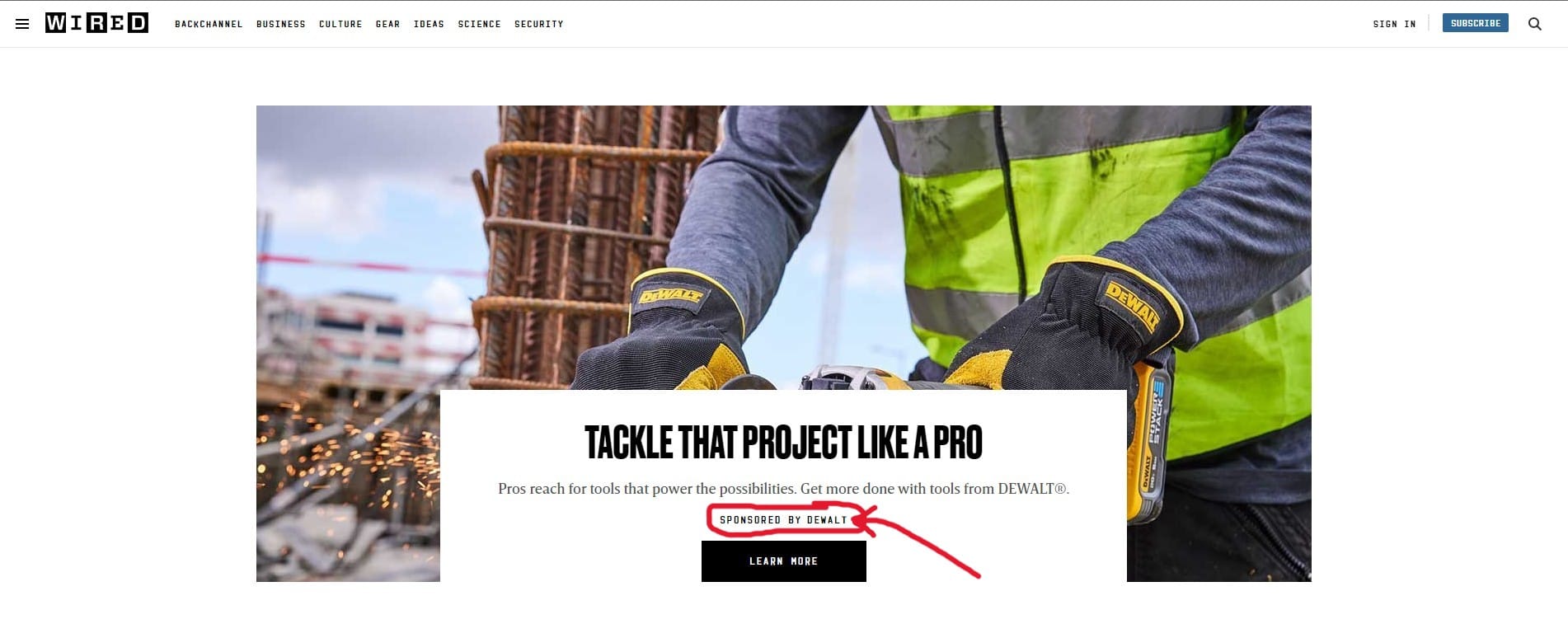
When you create native ads, you build them into a site’s design and they exist as part of the site’s content. Examples of native advertising on websites and social media platforms include “sponsored” or “paid” content posts, pay-per-click (PPC) search engine marketing campaigns, “advertorial” articles in newspapers and magazines, and infomercials on TV. Native ads have an editorial look and feel and are less obtrusive and hard selling than other forms of digital advertisements. Native ads commonly appear as text, images, videos, audio, links, social media posts, etc. They are often used to promote products and services within the context of a news article, blog post, video, or podcast, as in the example below from WIRED:
The Benefits of Native Advertising
Native advertising is ideal for driving traffic to your website and has a higher click-through rating (CTR) than display ads. According to a recent study, native ads are viewed 52% more than display ads, and they contribute to greater brand awareness. Consumers also interact with native advertisements 20% to 60% more than they do with standard display advertisements.
What is Display Advertising?
Simply put, display advertising is a visual-based form of online advertising that communicates a commercial message and is superimposed on the users’ experience. Display ads help promote businesses whenever people are browsing online, watching YouTube videos, checking their email, or using mobile devices and apps.
What Does Display Advertising Look Like?
Unlike text-based ads, display ads show up on websites, apps, and social media platforms—not in SERPs (Search Engine Results Pages). The original name for display ads was “banner ads.” Banner ads showed up as hyperlinked, image-based ads shaped like a banner, or strip. These ads were usually located at the top of a web page. Eventually, banner ads evolved into display ads, which now include interactive elements such as videos, pop-ups, and more. See the example of a display ad from Amazon’s home page below:

The Benefits of Display Advertising
Display advertising, much like native advertising, can boost brand awareness and intent to purchase. Display advertising is especially helpful in familiarizing your audience with your brand and creating initial interest. In fact, a recent study found that brand awareness increased by 21% in campaigns that utilized digital display ads. Display ads also allow for remarketing opportunities. Remarketing allows your business to position targeted display ads in front of a specific audience. The benefit here is that this audience segment has previously engaged with your ad, i.e., visiting your website. Once a potential customer knows about your brand, a well-placed display ad can remind them to make a purchase.
Display or Native Ads—or Both?
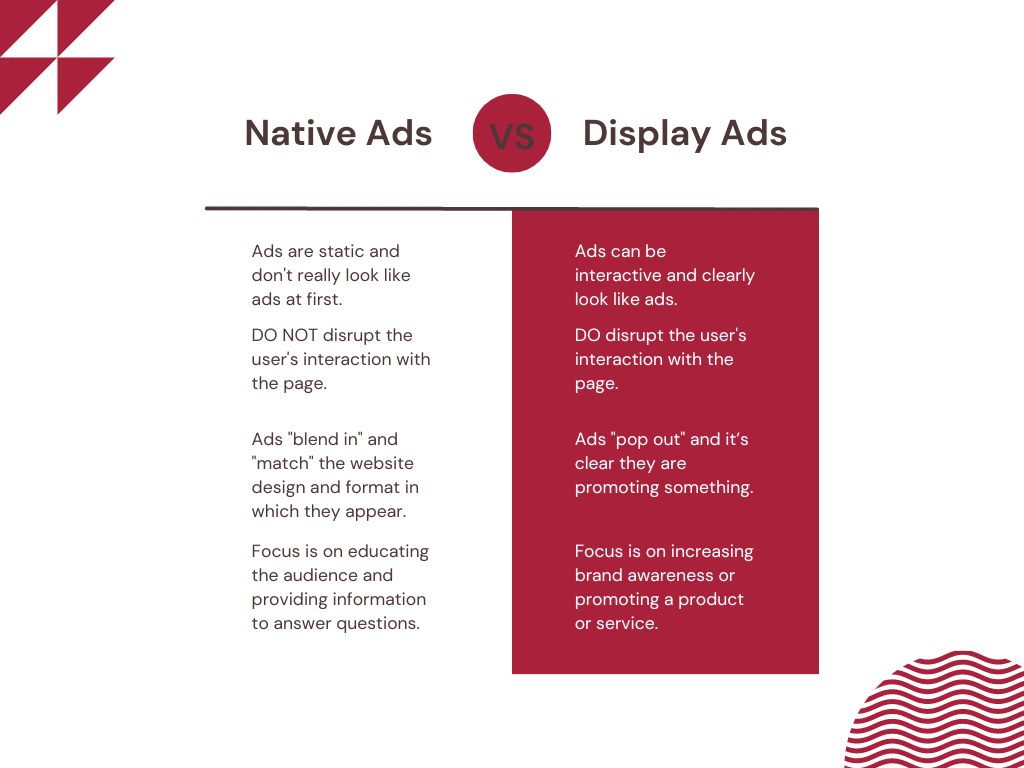
Programmic advertising—the automated buying and selling of online advertising space—has made placing native advertisements easier than ever. Since many consumers use pop-up blockers (or similar software), native advertising is a good workaround marketing option. However, because of the reasons we just outlined, display ads are still relevant and especially important for building brand awareness and retargeting opportunities. Smart marketers will use their budgets to effectively create a combined content distribution strategy that will leverage the strengths of both native and display ads.
Planning and executing a digital advertising campaign can be overwhelming and time consuming. Let the marketing experts at Millennium Agency create a step-by-step plan specific to your business. Give us a call to discuss your marketing goals today.
About Millennium Agency
Millennium Agency is a national, award-winning, digital, creative, content/PR, and video marketing firm. With offices in Boston and New Hampshire, our team unites creative branding and data analytics to accelerate our clients’ growth, while combining our clients’ vision with our marketing expertise to increase sales opportunities and drive brand success. From video advertising and web design to social media and PR, Millennium can guide your marketing efforts every step of the way. Contact the professionals at Millennium Agency to learn more!
Linda Fanaras is the President and Founder of Millennium Agency located in Manchester, NH, and Boston. She can be reached at 877-873-7445 or [email protected].