
Executive Summary
Many technical B2B companies assume their biggest challenge is educating the market.
In reality, their biggest challenge is translating complexity into clarity.
Whether you’re developing AI software, manufacturing advanced components, engineering medical devices, building industrial automation systems, or delivering highly specialized professional services, your expertise often becomes your greatest communication obstacle.
Internal teams understand every specification, process, and capability. Prospective customers do not.
The result isn’t simply longer sales cycles. It’s missed opportunities, inconsistent messaging, weaker differentiation, and buyers who struggle to understand why your solution is different from every other company making similar claims.
At Millennium, we’ve seen this challenge across manufacturing, technology, healthcare, life sciences, and energy organizations. It’s why we’ve developed what we call the Complexity Translation Framework™—a practical approach to helping organizations communicate sophisticated solutions without oversimplifying their value.
In this article, you’ll learn:
- Why technical companies often struggle to explain what they do
- The hidden costs of unclear messaging
- The four stages of the Complexity Translation Framework™
- Practical ways to improve messaging across your organization
- How clearer communication strengthens sales, marketing, recruiting, and long-term brand equity
Complexity Isn’t the Problem
Complexity is often viewed as something that needs to be reduced.
We disagree.
Complexity is frequently what makes a company valuable.
Proprietary technologies.
Advanced manufacturing processes.
Scientific expertise.
Regulatory knowledge.
Years of engineering innovation.
These aren’t obstacles.
They’re competitive advantages.
The real challenge is helping someone who doesn’t share your expertise understand why those advantages matter.
That’s where many organizations lose momentum.
Instead of communicating outcomes, they communicate specifications.
Instead of telling a compelling story, they describe features.
Instead of building confidence, they overwhelm prospective customers with technical language that assumes prior knowledge.
Buyers don’t reject complexity because it’s difficult.
They reject confusion because it creates risk.
When a prospect cannot quickly understand what you do, how you’re different, or why you’re the right partner, uncertainty replaces confidence.
And uncertainty delays buying decisions.
Why Technical Companies Fall Into This Trap
Technical organizations don’t struggle because they lack expertise.
They struggle because everyone inside the company has already crossed what psychologists call the “curse of knowledge.”
Once you know something deeply, it becomes extremely difficult to remember what it feels like not to know it.
Engineers naturally speak to engineers.
Developers explain solutions from an architectural perspective.
Executives discuss operational capabilities.
Customers, however, rarely begin with that same level of understanding.
They’re usually asking much simpler questions:
- Can this solve my problem?
- Why is this different?
- Why should I trust you?
- How difficult is implementation?
- Is this worth the investment?
Those questions often remain unanswered because organizations are busy explaining how something works before explaining why it matters.
Five Common Messaging Mistakes Technical Companies Make
1. Leading With Features Instead of Business Outcomes
Consider these two examples.
Example A
Our platform leverages machine learning models, edge computing architecture, and predictive analytics.
Technically accurate.
But what problem does it solve?
Now compare it with:
Example B
Our platform helps manufacturers identify equipment failures before they cause costly downtime.
The second explanation immediately answers a business question.
Technical details still matter.
They’re simply introduced after establishing relevance.
2. Assuming Buyers Want Every Detail Immediately
Subject matter experts often feel compelled to explain everything.
Buyers don’t need everything on day one.
They need enough clarity to continue the conversation.
Effective messaging works like a staircase.
Each interaction reveals another level of understanding rather than presenting every capability at once.
3. Speaking Different Languages Across Departments
Marketing describes the company one way.
Sales explains it another.
Engineering uses completely different terminology.
Customer success develops yet another version.
Over time, prospects encounter inconsistent messaging depending on who they talk to.
That inconsistency creates friction.
Strong brands don’t necessarily have simpler offerings.
They communicate consistently across every customer touchpoint.
4. Confusing Accuracy With Clarity
Many organizations worry that simplifying technical language somehow diminishes credibility.
The opposite is often true.
Clarity demonstrates confidence.
The most respected experts rarely use complexity to impress people.
They use clarity to help people understand.
Albert Einstein is often credited with saying:
“If you can’t explain it simply, you don’t understand it well enough.”
Whether or not he said those exact words, the principle remains valuable.
Clear communication isn’t about removing expertise.
It’s about making expertise accessible.
5. Believing Messaging Is Just a Marketing Problem
Messaging influences far more than website copy.
It shapes:
- Sales presentations
- Investor conversations
- Recruiting
- Product launches
- Customer onboarding
- Strategic partnerships
- Public relations
- Analyst briefings
- Acquisition readiness
Organizations with strong messaging don’t simply market more effectively.
They operate more consistently.
The Hidden Cost of Confusing Messaging
Poor messaging doesn’t always announce itself.
Instead, it quietly appears throughout the customer journey.
You may notice:
- Sales calls that begin with lengthy explanations.
- Website visitors who leave after viewing a single page.
- Prospects who request repeated clarification.
- Marketing campaigns that generate traffic but few qualified leads.
- Sales teams creating their own presentations because official messaging doesn’t resonate.
- New employees struggling to describe what the company actually does.
- Customers who understand individual products but not the broader value your organization delivers.
Each issue may seem unrelated.
Together, they point to a common problem:
Your expertise isn’t being translated into language your audience can immediately understand.
Those issues become even more costly when you consider that today’s B2B buyers complete much of their evaluation independently before engaging with a vendor.
By the time prospects reach your website or request a conversation, your messaging has already begun shaping their perception of your expertise and credibility.
New products, acquisitions, new markets, and larger sales teams only amplify inconsistencies if a clear messaging foundation isn’t already in place.
Introducing the Complexity Translation Framework™
At Millennium, we believe the goal isn’t to simplify your business.
It’s to simplify understanding.
That’s the purpose of the Complexity Translation Framework™.
Rather than stripping away technical depth, the framework organizes communication so every audience receives the right level of information at the right time.
It consists of four connected stages:
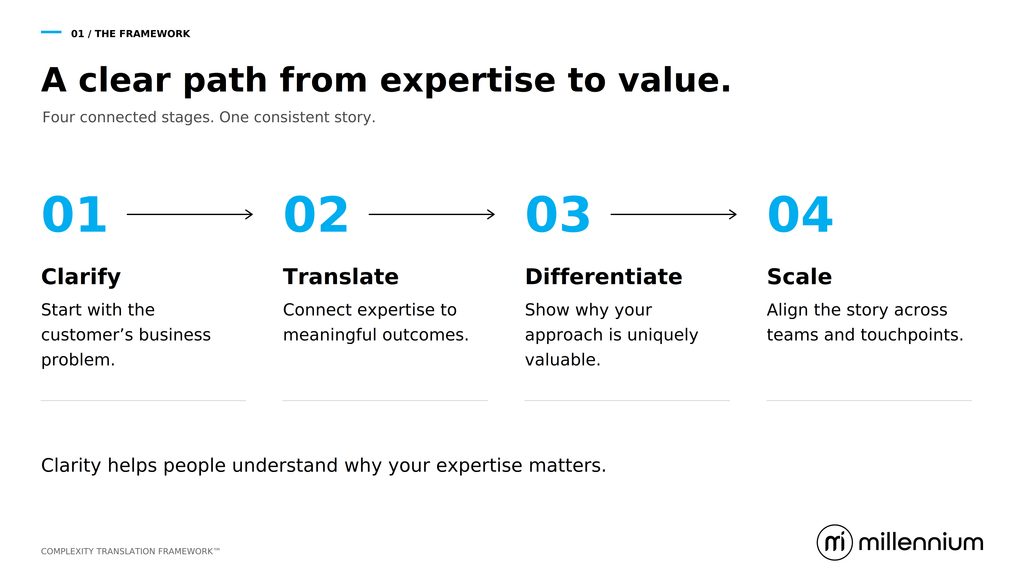
1. Clarify
Identify the business problem your audience is actually trying to solve.
Not the technology.
Not the process.
The problem.
2. Translate
Convert technical capabilities into business outcomes using language executives, buyers, engineers, and stakeholders can all understand.
3. Differentiate
Show why your approach matters.
Many companies explain what they do.
Far fewer explain why they’re uniquely positioned to do it better.
4. Scale
Ensure every department communicates from the same strategic foundation, creating consistency across marketing, sales, recruiting, investor relations, and customer experience.
In the next section, we’ll explore each stage in detail and examine how organizations can apply the framework to strengthen messaging across every stage of the buyer journey.
Applying the Complexity Translation Framework™
Understanding the framework is one thing. Applying it consistently across your organization is where the real transformation happens.
Each stage builds on the previous one, helping technical organizations move from explaining what they do to communicating why it matters.
Stage 1: Clarify the Problem Before the Product
Many technical companies start conversations with their solution.
Customers start with their problem.
That disconnect creates immediate friction.
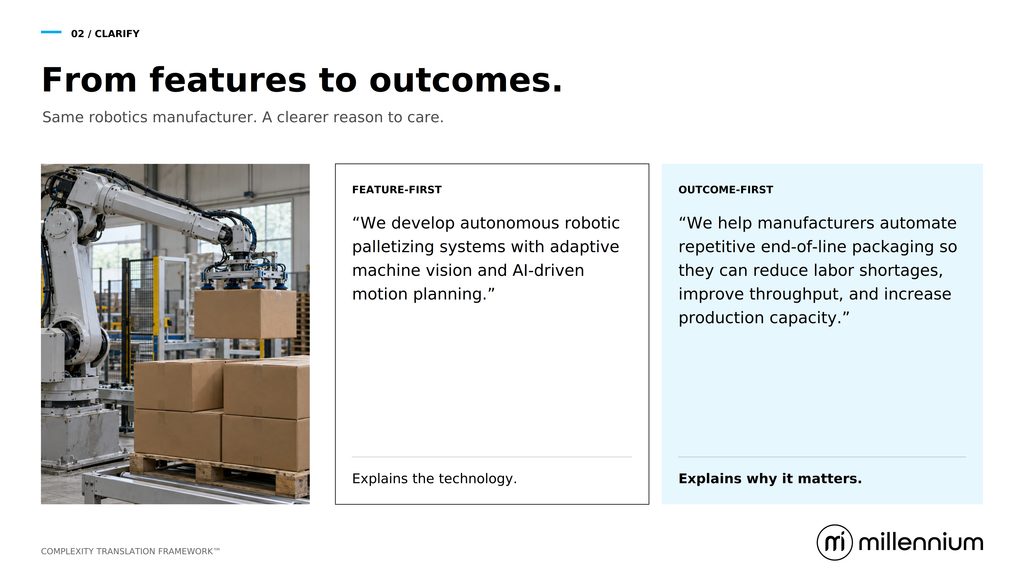
Imagine a robotics manufacturer introducing itself like this:
“We develop autonomous robotic palletizing systems with adaptive machine vision and AI-driven motion planning.”
Now imagine they instead say:
“We help manufacturers automate repetitive end-of-line packaging so they can reduce labor shortages, improve throughput, and increase production capacity.”
Both statements describe the same company.
Only one immediately answers the buyer’s biggest question:
Why should I care?
Before discussing your technology, identify:
- What business challenge does your customer face?
- What risks are they trying to reduce?
- What opportunity are they trying to capture?
- What happens if they do nothing?
When organizations lead with customer challenges rather than internal capabilities, technical conversations become easier—not harder.
Questions Every Leadership Team Should Ask
Before reviewing any messaging, ask:
- Could someone outside our industry explain what we do after visiting our website for two minutes?
- Are we describing our products or the problems they solve?
- Would a CEO understand our value as quickly as an engineer?
- Does every department describe our company the same way?
If those answers aren’t consistently “yes,” messaging deserves strategic attention.
Stage 2: Translate Technical Expertise Into Business Value
Translation doesn’t mean removing technical detail.
It means sequencing information appropriately.
Technical buyers still want specifications.
Engineers still care about architecture.
Scientists still evaluate methodology.
But before buyers invest time understanding how something works, they first need confidence that it’s worth understanding.
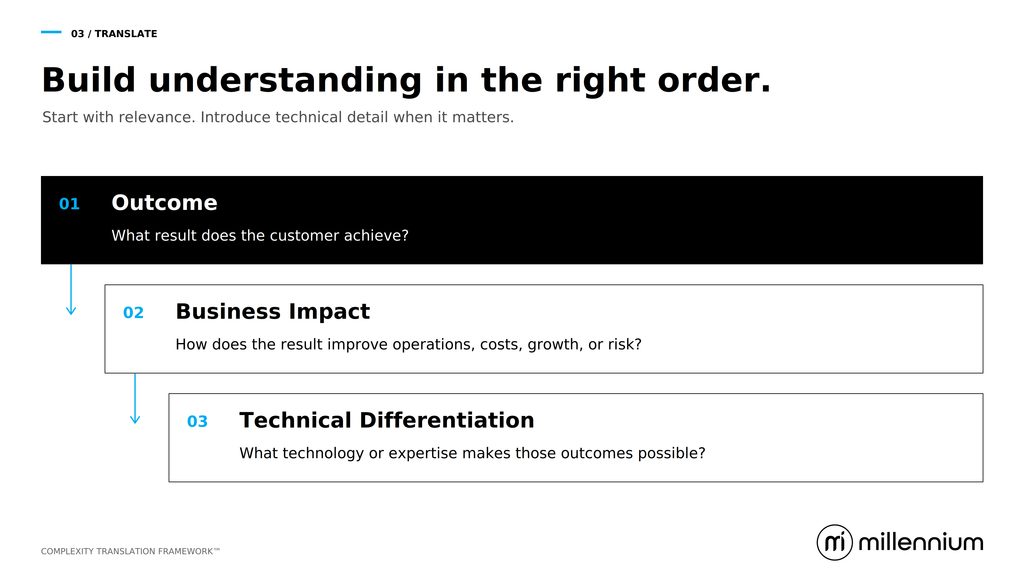
Think of messaging as layered communication.
Layer One: Outcome
What result does the customer achieve?
Layer Two: Business Impact
How does that result improve operations, reduce costs, accelerate growth, or minimize risk?
Layer Three: Technical Differentiation
Only after establishing relevance should you explain the technology that makes those outcomes possible.
Companies frequently reverse this order.
As a result, prospects become buried in details before they’ve developed enough context to appreciate them.
Example: Translating Complexity
Consider an industrial software company.
Technical Description
“Our platform utilizes predictive analytics, machine learning algorithms, and cloud-native architecture to optimize production environments.”
Now compare it with:
Translated Description
“We help manufacturers identify production issues before they become costly disruptions, reducing downtime while improving operational efficiency.”
The technical explanation isn’t wrong.
It’s simply incomplete.
It explains how without first explaining why.
Once customers understand the outcome, they’re far more interested in learning about predictive analytics, AI models, and cloud infrastructure.
Translation creates curiosity.
Jargon often creates confusion.
Stage 3: Differentiate Beyond Features
Many technical industries have reached messaging parity.
Every company claims to be:
- Innovative
- Trusted
- Experienced
- Customer focused
- Quality driven
- Results oriented
- Industry leading
These statements aren’t differentiation.
They’re expectations.
True differentiation comes from helping buyers understand why your organization approaches problems differently.
Instead of asking:
“What do we do?”
Ask:
“Why do customers choose us instead of capable competitors?”
That answer rarely comes from product specifications alone.
It often comes from factors such as:
- Regulatory expertise
- Industry specialization
- Implementation methodology
- Customer experience
- Strategic guidance
- Cross-functional collaboration
- Manufacturing capabilities
- Speed to market
- Proven outcomes
Those strengths should become central to your messaging (not buried several pages into your website).
The Difference Between Features and Meaning
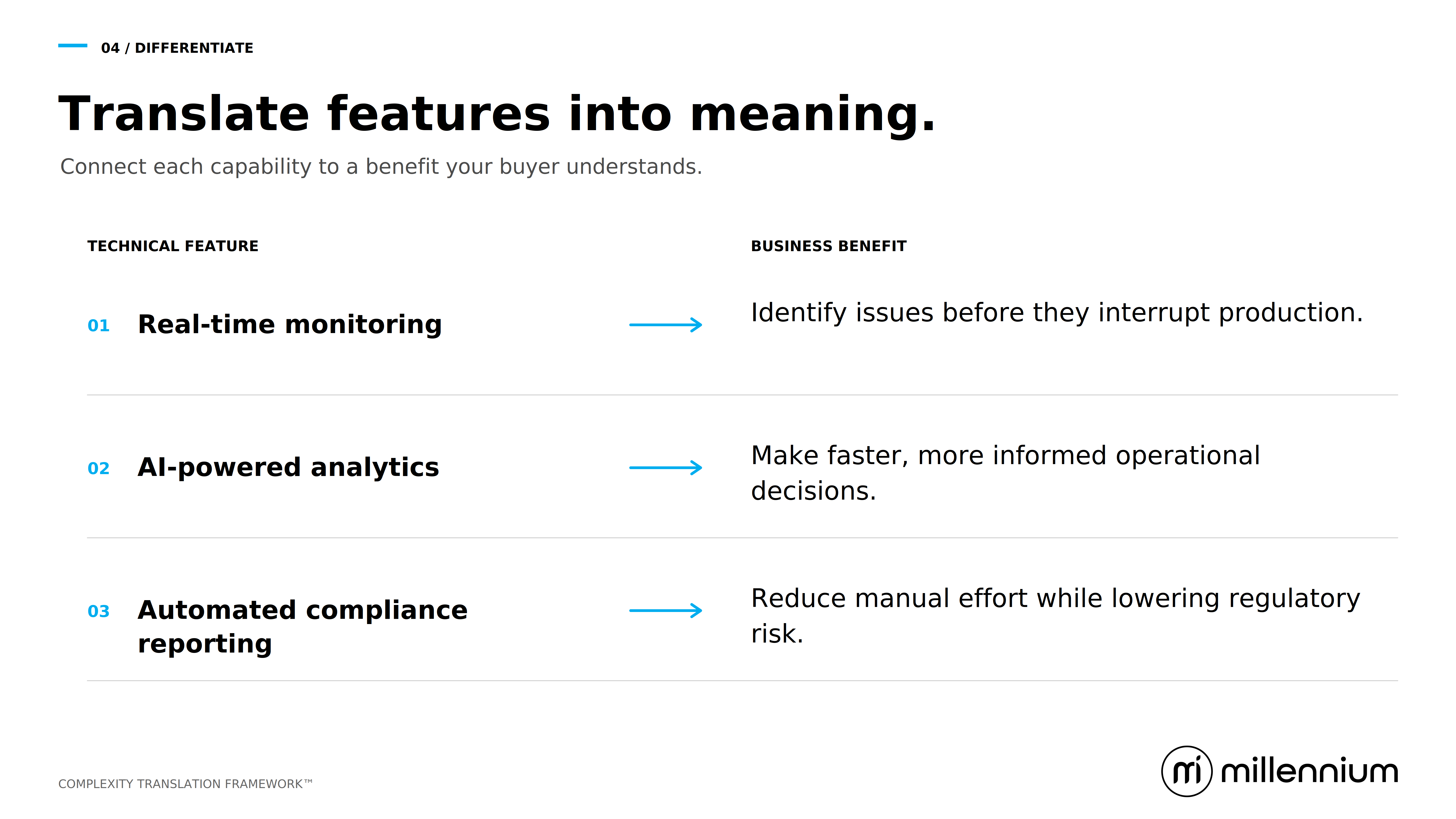
Every feature should answer a customer question.
For example:
Feature
Real-time monitoring
Meaning
Identify issues before they interrupt production.
Feature
AI-powered analytics
Meaning
Make faster, more informed operational decisions.
Feature
Automated compliance reporting
Meaning
Reduce manual effort while lowering regulatory risk.
Features describe products.
Meaning communicates value.
Strong messaging consistently bridges the gap between the two.
Stage 4: Scale Consistent Messaging Across the Organization
One of the biggest misconceptions about messaging is that it’s owned by marketing.
In reality, messaging is an organizational asset.
Sales depends on it.
Recruiters depend on it.
Executives depend on it.
Product teams depend on it.
Customer success depends on it.
Investor relations depends on it.
When every department develops its own explanation of the company, prospects experience an inconsistent brand regardless of how polished the website looks.
Consistency builds confidence.
Confidence builds trust.
Trust shortens buying cycles.
Developing that level of alignment often requires a strategic approach to B2B branding services that connects positioning, messaging, visual identity, and customer experience into a cohesive brand.
What Consistency Actually Looks Like
Organizations that communicate effectively usually have alignment around a handful of foundational ideas.
Everyone understands:
- The company’s purpose
- The problems it solves
- The audiences it serves
- What differentiates it
- Why customers choose them
- How success is measured
Individual conversations naturally vary depending on the audience.
But they all originate from the same strategic narrative.
That’s the difference between memorizing a script and sharing a shared understanding.
Why This Matters More in Complex Buying Committees
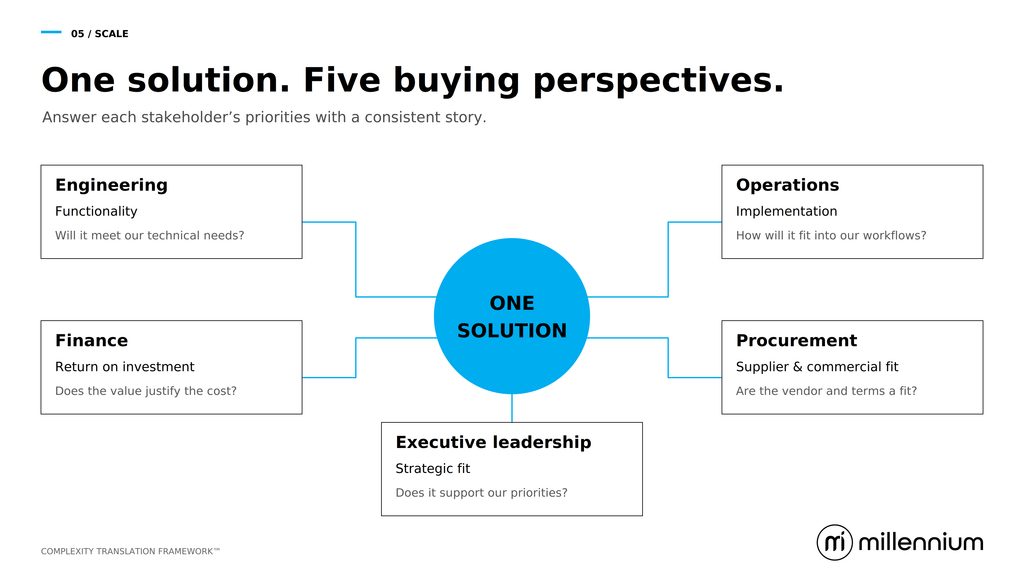
Today’s B2B purchases rarely involve a single decision-maker.
Technical companies often sell to buying groups that include:
- Engineers
- Operations leaders
- Procurement
- Finance
- IT
- Executive leadership
- Legal or compliance teams
Each stakeholder evaluates solutions differently.
Engineers may prioritize functionality.
Finance evaluates ROI.
Operations focuses on implementation.
Executives assess strategic fit.
If your messaging only resonates with one audience, momentum slows as conversations move through the organization.
Clear messaging acts as a common language across every stakeholder.
That consistency matters because modern B2B buying journeys are nonlinear and often involve multiple decision-makers evaluating solutions from different perspectives, making it even more important that every interaction reinforces the same strategic narrative.
Why Complexity Is Becoming a Competitive Advantage
Artificial intelligence has made it easier than ever to produce marketing content.
Ironically, it’s also made authentic expertise more valuable.
Many companies now sound remarkably similar.
Their websites promise innovation.
Their messaging follows familiar templates.
Their differentiation becomes increasingly difficult to recognize.
Organizations with genuine technical expertise have an opportunity.
Rather than simplifying their capabilities into generic marketing language, they can translate complexity into clarity while preserving the depth that competitors can’t easily replicate.
That’s where lasting differentiation emerges.
Not from saying less.
From helping customers understand more.
What Great Technical Messaging Looks Like
Organizations that communicate complex ideas effectively don’t necessarily have simpler products.
They’ve simply become intentional about how they communicate them.
Instead of overwhelming prospects with information, they create clarity, build confidence, and guide buyers through increasingly detailed conversations.
The difference isn’t what they know.
It’s how they share what they know.
Below are several characteristics consistently found in high-performing technical brands.
They Start With the Customer’s World, Not Their Own
It’s natural to want to explain years of innovation, proprietary processes, or breakthrough technology.
But buyers aren’t looking for a history lesson.
They’re looking for answers.
The strongest messaging starts where the customer already is.
Instead of asking prospects to enter your world, it meets them in theirs.
For example, a life sciences company may be tempted to describe its advanced laboratory capabilities, specialized instrumentation, and scientific methodology.
Those capabilities certainly matter.
But the conversation becomes much more compelling when it begins with the outcome:
- Accelerating time to market
- Reducing regulatory risk
- Improving reproducibility
- Increasing confidence in clinical decisions
The science supports those outcomes.
It shouldn’t overshadow them.
They Earn Technical Credibility Instead of Assuming It
Some organizations worry that simplifying language will make them appear less sophisticated.
In practice, the opposite often happens.
Clear communication demonstrates mastery.
Think about the most respected engineers, researchers, physicians, or executives you’ve encountered.
They rarely rely on unnecessarily complex language.
Instead, they have the ability to explain difficult concepts in ways that make others feel informed rather than intimidated.
That ability creates trust.
Customers don’t need proof that your team knows the science.
They need confidence that your team understands their business.
They Build Messaging Around Decisions, Not Products
One subtle shift can dramatically improve messaging.
Instead of organizing your communications around products, organize them around customer decisions.
Consider the difference.
Product-focused navigation
- Software Platform
- Analytics Suite
- Monitoring System
- Professional Services
Decision-focused navigation
- Reduce Downtime
- Improve Operational Visibility
- Prepare for Regulatory Audits
- Scale Production More Efficiently
Both describe the same offerings.
The second aligns more closely with how buyers think.
People don’t wake up looking for software.
They wake up trying to solve business problems.
They Recognize That Every Audience Needs a Different Conversation
One of the biggest communication mistakes technical organizations make is assuming everyone needs the same explanation.
A plant manager evaluating operational improvements has different priorities than a CFO evaluating return on investment.
An engineer evaluating technical specifications asks different questions than a procurement leader focused on implementation risk.
Effective messaging doesn’t create separate company stories for every audience.
It creates one strategic narrative that can be adapted without becoming inconsistent.
The message evolves.
The foundation stays the same.
The Strategic Benefits Extend Far Beyond Marketing
Organizations often begin improving messaging because they want better marketing results.
They quickly discover benefits throughout the business.
Clear messaging helps sales teams qualify opportunities faster because prospects arrive with a stronger understanding of the company’s value.
Recruiters attract candidates who better understand the organization’s purpose and culture.
Customer success teams spend less time correcting expectations established during the sales process.
Executives communicate more consistently with investors, partners, and industry analysts.
Even product teams benefit because customer feedback becomes easier to interpret when everyone shares the same language.
As buyer expectations continue to evolve, organizations that consistently communicate value across every touchpoint are better positioned to build trust with increasingly informed buying groups.
Ongoing research into B2B buyer behavior and decision-making continues to reinforce the importance of strategic messaging throughout the customer journey.
Organizations that communicate with clarity are better positioned to build trust, differentiate in competitive markets, and create stronger business outcomes over time.
For a deeper look at how strategic branding influences business performance, read our Why Strong Brands Win: 9 Business Outcomes That Matter eBook.
When Is It Time to Revisit Your Messaging?
Most organizations don’t decide to update their messaging because they suddenly become dissatisfied with their website.
The need usually emerges during periods of growth or change.
Common indicators include:
- Launching a new product or service
- Entering a new market
- Expanding internationally
- Acquiring another company
- Preparing for investment or acquisition
- Reaching a new stage of organizational maturity
- Experiencing longer sales cycles
- Receiving inconsistent feedback about what the company actually does
These moments create an opportunity to strengthen the strategic foundation that supports future growth.
In fact, preparing for major milestones such as mergers, acquisitions, or public offerings requires more than visual rebranding.
It requires a clear, credible story that investors, customers, employees, and stakeholders can all understand. In an upcoming article, we’ll explore rebranding before an acquisition or IPO and examine the messaging mistakes that can unintentionally reduce perceived company value.
Likewise, if your organization is wrestling with increasingly complex offerings, our upcoming guide to B2B branding for complex products will explore how positioning, messaging, and brand architecture work together to create clarity at scale
A CEO Checklist for Evaluating Your Company’s Messaging
If you’re unsure whether your messaging is helping or hindering growth, ask yourself these questions.
Can someone outside your industry explain what your company does after reading your homepage?
Does every department describe the organization in roughly the same way?
Are you leading with customer outcomes before technical capabilities?
Can your sales team clearly articulate why customers choose you over competitors?
Would an investor, prospective employee, or strategic partner hear the same core story as a customer?
Are your products organized around business problems or internal terminology?
Do your website, presentations, proposals, and sales conversations reinforce one consistent narrative?
If you answered “no” or “I’m not sure” to several of these questions, the challenge may not be your technology.
It may be how that technology is being communicated.
Fortunately, messaging is one of the few strategic assets that can improve every customer interaction once it’s built on the right foundation.
The goal isn’t to make your business sound simpler.
It’s to make its value easier to understand.
Conclusion: Translating Complexity Into Competitive Advantage
Technical expertise has never been more valuable.
But expertise alone doesn’t drive growth.
Understanding does.
The organizations that consistently outperform their competitors aren’t always the ones with the most advanced technology or the longest list of capabilities. More often, they’re the ones that make it easiest for customers, employees, investors, and partners to understand why those capabilities matter.
That’s the difference between communicating information and creating clarity.
Throughout this article, we’ve explored how technical organizations can move beyond feature-heavy messaging by applying the Complexity Translation Framework™:
- Clarify the customer’s challenge before introducing the solution.
- Translate technical capabilities into meaningful business outcomes.
- Differentiate by communicating what makes your approach uniquely valuable.
- Scale consistent messaging across every audience and every touchpoint.
These principles don’t simplify your expertise. They amplify it.
As markets become more competitive and buying decisions involve larger groups of stakeholders, organizations that communicate with clarity will continue to build trust faster, shorten sales cycles, strengthen brand equity, and create more opportunities for sustainable growth.
For technical companies, complexity isn’t the obstacle.
It’s the opportunity.
The companies that learn to translate it will be the ones that stand out.
We’ve seen firsthand how clearer positioning and messaging can strengthen lead generation and increase brand visibility for technical organizations.
See how Global American improved lead generation and online brand awareness through a strategic branding and digital marketing initiative.
Complexity, translated.
At Millennium, we partner with organizations whose expertise deserves to be understood.
Whether you’re refining your positioning, launching a new offering, preparing for growth, or aligning your messaging across marketing, sales, and leadership, we help transform technical complexity into strategic clarity.
If your organization is ready to build a brand that communicates as powerfully as it innovates, let’s start the conversation.
Schedule a Brand Strategy Consultation ↗
Frequently Asked Questions
Why do technical B2B companies struggle to explain what they do?
Technical organizations often experience what’s known as the “curse of knowledge.” Internal experts understand their products so deeply that they unintentionally communicate using industry terminology, assumptions, and technical details that prospective customers don’t yet understand. Effective messaging starts with customer problems and business outcomes before introducing technical capabilities.
How can you explain a complex product more effectively?
The most effective approach is to begin with the business problem your product solves, explain the measurable outcomes customers achieve, and then introduce the technology that makes those outcomes possible. This progression helps audiences understand why the product matters before learning how it works.
What is the difference between technical messaging and brand messaging?
Technical messaging explains how a product or solution functions. Brand messaging explains why your organization exists, the problems it solves, and why customers should choose you over competitors. Strong B2B companies align both so technical credibility supports a larger strategic narrative rather than existing independently.
Why is clear messaging important for technical companies?
Clear messaging improves far more than marketing performance. It helps sales teams communicate consistently, shortens buying cycles, strengthens recruiting efforts, supports investor communications, improves customer onboarding, and creates a more cohesive brand experience across every department.
How does messaging affect B2B buying decisions?
Modern B2B purchases often involve multiple stakeholders, including executives, engineers, finance leaders, procurement teams, and operations managers. Clear messaging provides a common language that helps each audience understand the value of a solution from their own perspective while maintaining a consistent overall brand story.
What is brand positioning for complex companies?
Brand positioning defines how an organization wants to be understood within its market. For technical companies, effective positioning goes beyond describing products or services. It communicates the unique value, expertise, and perspective that differentiate the organization in the minds of customers. In an upcoming article, we’ll explore B2B Brand Strategy: The Complete Guide for Complex Companies, including how positioning serves as the foundation for long-term growth.
When should a company revisit its messaging strategy?
Organizations should evaluate their messaging whenever they experience significant change, such as entering new markets, launching products, acquiring another business, preparing for investment, or targeting new customer segments. Messaging should evolve alongside the business to ensure it continues to support strategic objectives.
How is messaging related to brand equity?
Consistent, clear messaging helps customers understand, remember, and trust a company over time. Those repeated positive perceptions contribute directly to stronger brand equity by increasing recognition, credibility, and preference within the market. In our latest guide, What Is Brand Equity and How Do B2B Companies Build It? we examined how messaging, customer experience, and positioning work together to create long-term business value.
Recommended Reading
Continue exploring how strategic branding helps complex organizations communicate with clarity:
- B2B Branding for Complex Products: A Framework for Technical Companies (Coming Soon)
- Messaging That Survives the Engineer and the CEO: B2B Brand Architecture (Coming Soon)
For additional insights, you may also enjoy: