
Though it has been around forever, content marketing seems to be the industry’s favorite buzzword lately. Producing quality content that generates a high level of engagement is every marketers dream. But, in light of this content frenzy some marketers have been quick to call other forms of marketing “dead,” which is the case for search engine optimization (SEO). Some have even claimed content marketing has replaced SEO all together.
We’re here to tell you that’s not the case. In fact, content marketing drives SEO. You can’t have content marketing without SEO, and you can’t have SEO without content marketing. Today, marketers of all kinds are quickly learning that when used together, these two practices produce valuable results.
Working Together
Content marketing and SEO’s functions drastically improve when used simultaneously. Over the years, SEO has transformed from providing exact keyword search results to topical keyword search results. Previously, marketers would arbitrarily insert keywords into content to increase rankings (even if this diminished the content quality). With topical search results, content creators can focus on the quality of the content. However, it is still advised to consciously incorporate exact keywords in your page titles, headers, and meta descriptions. By doing this, you are still practicing good SEO without sabotaging your content.
If your content is relevant and engaging, SEO keywords will thrive. You won’t need to purposely insert keywords if you are providing content your audience truly wants to see. And with high-quality content comes the opportunity for more backlinks to your site. Again, you are practicing SEO through your content marketing strategy.
Even better, the web can document customer response. By reviewing what your audience is saying in comments on and shares of your posts, you can verify your keywords or learn what keywords you should be incorporating.
Keep in mind that using content marketing and SEO hand-in-hand is a long-term process. Do not expect to immediately see results. Instead, continue to satisfy customers with quality content and you will see a strong SEO improvement over time.
Why a Content-SEO Mix is Better Than SEO Only
It is important to recognize that content marketing does not involve paid content. Content marketing is a low-budget form of SEO. While paid SEO practices can be negatively affected by Google updates and software malfunctions, content marketing is not. And while you are focusing on creating high-quality content for SEO purposes, you are, overall, improving your website in the process.
With the production of frequent and interesting content, you are also increasing your social media presence. Hundreds–even thousands–of shares, likes, mentions, and retweets can result. With this newfound social presence, you are fostering a better relationship between your brand and the customer. The chain of reaction that occurs from content marketing and SEO use benefits all areas of your company.
Best Practices for Content Marketing SEO
Stay focused on producing the right content for your audience. When you master creating high-quality, relevant posts, SEO can easily do its job. Also, by putting your all your content on one domain, you are funneling your traffic directly to your content. Again, this allows for easy SEO analysis.
Good content is easily understood, actionable, engaging, and relevant. Relevancy is crucial to content marketing and SEO success. Don’t produce content that isn’t consistent with your company’s image. Not only will this hinder your SEO, but will create a disconnect from your brand.
If you are unsure of if your content marketing and SEO habits are successful, you can run a site audit to determine your areas of strengths and weaknesses. Understanding that content marketing and SEO are most effective when used together will allow for major results. Your content and your optimization will undoubtedly flourish with this pair.
As time goes on, website developers not only deal with changing technology but with changing website designs as well. Years ago, developers focused on skeuomorphism because they thought this was the most creative and innovative technique. Recently, we have seen both flat and material design come into the spotlight. These versions of modern website design offer quicker production techniques and faster load times; however, they have lost some of the creative ability skeuomorphism brought to websites. All of these designs, both new and old, can contribute to a creative website design if chosen correctly. To find the best option for your company, check out these three popular website designs and see if you can determine which one is best for you.
Skeuomorphism
For years, skeuomorphic design has given the user something they want in a website: the feeling of being at home. This theme gives elements within a webpage a more realistic look, allowing the user to feel like they are in an actual scene as the elements appear in a 3-D view. This realistic view is critical for the layout, as the objects appear to the user just as their material, shape, and function would in real life. Unfortunately, due to the newer trends mentioned earlier, skeuomorphism is now becoming less relevant, and developers are moving towards cleaner, more modern design elements.
Pros:
- It allows the user to feel a connection with the website as the objects appear familiar.
- The designer has the ability to trigger emotions by creating scenes within the web page.
- It gives the developer more creative options to express the company’s brand.
- It gives the appearance that the user can “click” on the objects, increasing the UX.
Cons:
- Too many design elements can confuse the user.
- A strong focus on design takes away from the actual content.
- Heavy design elements can lead to longer load times.
- Incorrect use of shadows and textures can alter the actual appearance of the product.
Flat Design
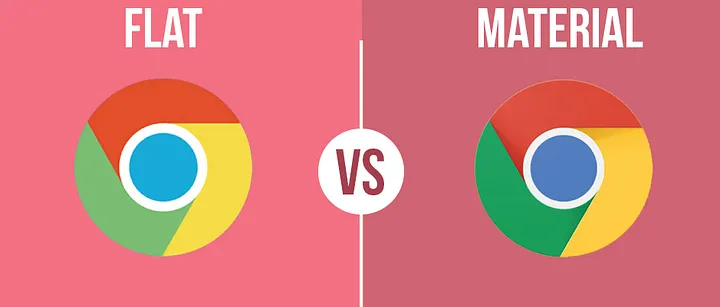
Unlike skeuomorphism, flat design brings a new, simple, and elegant template to the world. For developers, it is considered a more clean-cut and simplistic approach to websites. Flat design utilizes the 2-D interface options while allowing some room for creativity by developers. It focuses more on functionality than on the visual display by appearing on a completely flat surface. This becomes more beneficial for users as there are no flashy elements to confuse them while they navigate the website. This clean-cut appearance allows any company to look professional and welcoming. Although there is a lot of support for this clean-cut look, there are still some designers who miss the creative flexibility that skeuomorphism provides.
Pros:
- The lack of intricate design elements allows the site to function on several devices.
- Eliminates unnecessary elements to create a more simplistic design.
- Allows the user to quickly go through content.
- Allows for quick load times, as there is a lack of intricate designs.
Cons:
- Limited design options regarding color, shapes, and icon designs
- No shadows or shading on icons can confuse the user due to a lack of guidance.
- Can create a generic-looking site, preventing your brand from standing out.
- Lack of contrast and design has the possibility of boring users.
Material Design
Compared to flat design, material design provides the user with the opportunity to explore many different areas in a new and interactive way. With the use of the z-axis, material design brings back some elements of skeuomorphism, which allows for objects to appear in a three-dimensional way. Material design may not come with load times as fast as flat design, but it does provide developers with more color and layout options. Due to the use of the z-axis, it has the ability to guide the user through the webpage. With the illusion of one object floating over another, it is clear what buttons are clickable and where the user should go next. Although it can take longer to implement the theme, it makes the interaction with the UI feel real to the user, which, in the long run, can be beneficial for your business.
Pros:
- Comes with a set of detailed descriptions and leaves little room for guess work.
- Sites becomes easier to navigate with the use of the z-axis.
- Websites have the ability to perform across platforms.
- Provides built-in animations, eliminating the need to manually manage them.
Cons:
- Has the potential to drain users’ batteries due to the large number of animations.
- It is connected to Google, which may limit your uniqueness.
- Changing guidelines may be hard for some to keep up with.
- It takes longer to implement than a flat design.
With all of these different design options, the one thing to keep in mind is: who are you trying to reach? Would your users prefer something clean and simple or more exciting and interactive? Once you know the answers to these questions, you can pick a website design that fits you. The important concept to always remember is that no matter how professional or artistic your website may look, make sure your users understand it.

Image Credit: Medium
Being able to provide your customers with a user-friendly website that also allows them to interact and not get bored will be beneficial for your company, as they will spend more time searching. More time spent searching is beneficial for your company, as this has the potential to lead to large conversion rates.
To learn more about different web designs and how the proper one can help your business, contact us today for a free consultation.
(MANCHESTER, NH | BOSTON, MA) – Millennium Integrated Marketing (Millennium) increases their web design and development team with the addition of Devin Swett to the position of Lead Web Developer. As Lead Web Developer, Devin oversees the firm’s web development efforts with dynamic and creative custom website and user interface designs.
Devin Swett is a graduate of the New Hampshire Institute of Art with a Bachelor of Fine Arts degree. He brings his extensive experience in developing websites with HTML5, CSS, and JavaScript, as well as expertise in graphic design to Millennium’s clients. With the addition of Devin’s skillset, Millennium will be able to further provide clients with highly-engaging, innovative websites that increase brand awareness, inbound marketing opportunities and online presence.
“Millennium is very excited to welcome Devin Swett to the team,” says Linda Fanaras, President of Millennium Integrated Marketing. “His hire recognizes our continued dedication to pushing the technological and creative bounds of our website designs, and digital and online strategies.”
About Millennium Integrated Marketing
Millennium Integrated Marketing is a data-driven digital marketing, creative design and public relations firm that focuses on optimizing the digital customer experience. Millennium is a nationally recognized women-owned business and certified Google AdWords Partner with offices in Manchester, New Hampshire and Boston. The firm works with companies across industries, including higher education, technology, healthcare, non-profit, and professional services and can be found on Twitter, Facebook and LinkedIn. For more information, call Linda Fanaras at 877-873-7445 or visit www.mill-im.com.
With mobile technology evolving in a smartphone tethered society, it’s no surprise digital marketing success has become a focal point for many companies looking to drive business with an online presence. Digital marketing offers a world of opportunity, but is becoming highly competitive in an increasingly cluttered space. Marketing is no longer about repetition, where the company with the biggest advertising presence (or budget) triumphs, and has shifted towards developing personal connections with a product or service through the quality of brand exposure.
Customizing the user experience is not an easy task, but can lead to great success when executed correctly. Although, before success can be measured, there are three fundamental aspects a digital marketing strategy should cover: research before creating content, choose the right digital platforms for your brand and audience, and clearly define your goals/manage your campaigns so they’re always working and improving.
1. Evoke Emotion
Customer conversion relies heavily on the ability to capture an audience’s attention and keep them positively engaged with your brand throughout the buying cycle. Digital strategies should reflect this aspect by nurturing an emotional preference for your product or service by intrinsically understanding your customer’s needs and engaging them with highly tailored content.
As SAS, a business analytics provider, summarizes it: “People want brands they can trust, companies that know them, communications that are personalized and relevant, and offers tailored to their needs and preferences.” Customers also want you to deliver on your promise, because if you don’t there are plenty of other options a keystroke away and several online forums to discuss their displeasure. Your marketing plan should not only include methods for initiating positive interactions, but best practices for following up on and managing negative experiences. Sometimes simply acknowledging a customer’s issue and offering assistance can convert a detractor back into a brand advocate.
2. Pick Your Platforms
Digital marketing encompasses a vast array of electronic media you can utilize to promote your business, but the platforms you choose and the design of your content can have a big impact on the success of your marketing efforts. Regardless of your company size, location, industry, B2B or B2C services, people are talking about you. Make sure you are a part of the conversation. Knowing how these platforms operate and the composition of the audience using them is paramount to crafting your digital marketing campaigns.
Although digital platform options are increasing and some may be better suited to your goals than others, a general understanding of the major online players listed below is a good starting point.
Website
Your website is often one of the first touch-points a customer has with your company, whether it’s the landing page link from a paid ad or a direct search for your site. It is the first impression they’ll receive and a pivot point for whether or not they’ll pursue your services further. Use smart design and well-crafted content to stand out amongst the crowd. The website experience should seamlessly guide visitors through the buying process with clearly defined value proposition(s), ample resources for informed decision making and direction towards making a purchase. At a minimum, a good website is:
- Intuitively navigated
- Mobile friendly
- Content rich
Social Media Channels
Social media has become vital to digital marketing practices. It’s free to enter the arena and get the conversation going, but also offers targeted advertising options to increase visibility. The first step to customizing your social content is to take a look at your follower demographics and dig into the content they’ve been engaging with. If you haven’t launched any posts yet, be sure to do some research on your target market and develop a strategy around how you’re going to entice followers and continually supply them with appealing information. To help you discern where to direct your energy, here are some high level data points for the social media industry’s top players:
- Twitter reports having 302 million monthly users sending 500 million tweets per day. Tweets are restricted to short text of 140 characters and demographics point towards a younger audience (18-29 and 30-49).
- Facebook has 1.44 billion monthly active users and continues to dominate the social media space, but growth has slowed in comparison to other social channels. At a minimum, your social media strategy should include a Facebook business page.
- LinkedIn reports 347 million members in 200 countries with over 50% having college degrees and the highest segment of members falling into the 30-64 age range.
- Instagram has 300 million users sharing 70 million photos per day.
- Pinterest shows 72.8 million users pinning content with 85% of users being female.
YouTube
- YouTube has over 1 billion users uploading 300 hours of video every minute.
Blog
A blog allows you to push out custom content specifically related to your business, your customers, and the valuable information your audience needs to view you as a knowledgeable and reliable resource in your industry. It also provides dynamic content to improve your website’s SEO ranking.
Email Automation
Email automation is a great way to nurture leads and keep existing customers informed. This type of audience has elected to receive information from you and supplying behavior-triggered content at specific intervals helps prevent your customer interaction from becoming dormant.
Search and Display Advertising
There is a range of online advertising opportunities and various pricing structures. Here we’ll just cover some basic terminology to help you select which option is best aligned with your business goals.
- Search Ad – Text based ads that display alongside search results with related keywords.
- Display Ad – Ads in text, image, rich media, or video format that display on websites with related content.
- CPC – Cost Per Click. Drives traffic to a website or landing page.
- CPM – Cost Per Mile or Cost Per Thousand Impressions. Delivers a message/increases brand awareness.
- CPA – Cost Per Acquisition. Focused on conversion where a specific action takes place.
3. Analyze and Adjust
Monitoring results is just as important as developing the initial content strategy. If you take the wrong route to work each day and don’t eventually stop to determine if there is a better course, then you’ll never make it to your destination. Data driven marketing is smart marketing and almost all online platforms provide some type of analytics component. Your digital marketing campaigns should include success metrics and you should be monitoring the performance of your efforts to see if they are achieving your desired outcome.
(MANCHESTER, NH | BOSTON, MA) – Millennium Integrated Marketing (Millennium) is pleased to announce the recent hire of Sunisa Mathews to the position of Account Coordinator. As the Account Coordinator, Sunisa is responsible for the coordination and support of client projects and schedules, creative copywriting, media opportunities, and new business initiatives.
Sunisa has a Bachelor of Arts degree in Psychology from the University of Rochester where she also minored in Business with a concentration in marketing. Her broad perspective and eclectic approach to marketing give her a unique ability to develop engaging content and strategies for building brand awareness, as well as community relationships. She is an excellent team player with experienced communication skills, and assists in marketing strategy conceptualization, content development, and public relations campaigns.
“Sunisa brings a refreshing point of view to our marketing team with a unique background in both business and marketing,” says Linda Fanaras, President of Millennium Integrated Marketing. “Her attention to detail, positive attitude and team approach makes her a perfect fit for Millennium. We are pleased to have her here.”
About Millennium Integrated Marketing
Millennium Integrated Marketing is a digital marketing firm that integrates successful online and offline strategies for business growth. The firm seeks to become every client’s valued and trusted partner by providing dynamic ideas, strategies, and tactics that deliver measurable results. Millennium Integrated Marketing, with offices in Manchester, New Hampshire and Boston, works with companies across industries, including higher education, technology, healthcare, non-profit, and professional services. For more information, call 877-873-7445 or visit www.mill-im.com. Millennium Integrated Marketing can also be found on Twitter, Facebook, and LinkedIn.
Today, marketing is all about numbers. Big data, small data, analytics. Maybe we love numbers because they help us visualize our efforts. Maybe we love them because we can measure our results. Maybe the numbers make us feel safe when customer opinion and brand reputation are impossible to quantify. It’s easy to forget that qualitative data is just as important as quantitative data. Sometimes the numbers don’t tell the whole story. And in a world where the consumer has the power to post their honest opinions online for the world to see, you better make sure you are valuing user experience (UX) just as much as the numerical data.
Conversion rate optimization (CRO) is the key to balancing both outstanding UX and utilizing analytics in your favor. CRO is a strategy that involves analyzing and altering a business’s website in order to convert existing traffic into leads or sales. CRO can be analyzed through software. Its popular functions include A/B testing, multivariate testing, heat mapping, mobile analytics, concept testing and surveys — just to name a few. It can be used in conjunction with paid advertising, but it’s just as effective when used alone (and cheaper too!)
To be successful at CRO means you need to know more than just the number-crunching. Remember: customer experience is what defines your company. Always consider your customer’s needs when strategizing CRO. Your reputation lies heavily in the hands of your customers, not just the content or advertising you produce. Focus equally on your company’s reputation and the actual conversions when performing CRO. You can do this by prioritizing UX.
Providing superior UX requires performing consistent and detailed optimization. Look at every inch of your website. Even the smallest change, such as switching the header font, can increase conversion rates significantly. Not only will your research help increase conversions, but also help gain user trust and loyalty. Here are some tips on improving CRO efforts while focusing on UX.
 Don’t listen to your gut
Going against popular belief, here. But when it comes to CRO, “going with your gut” will get you nowhere. This cliché is dangerous advice; it keeps you locked in to the same, outdated habits you’re accustomed to. Numbers don’t lie. If you are starry-eyed over your web design but the data tells you the customers don’t agree, listen to the data. The beauty of CRO is that you use what you already have. No need to create a new website, just make a few edits and you’ll instantly see results. Go into it with an open mind and let CRO show you what efforts to ditch and what efforts are worth your time.
 Be the user
Let’s face it, you spend more time on your company’s website than any user. Your site’s flaws are masked by your familiarity. Take a step back and browse the site as if it were your first time. Be honest and recognize where your website becomes confusing or difficult. Is purchasing your product a time-consuming process or does it only require a few steps? Is it easy to find your contact page? Or will the user be squinting at the screen to find your company’s phone number? A fresh perspective is sometimes all it takes to maximize CRO.
Improve your conversion funnel
A conversion funnel, also referred to as a sales funnel, is the series of steps a user takes which results in sales or leads. Let’s say a user wants to buy a bike. Every step she takes-from searching for a bike on Google all the way to purchasing a bike on your website-is the conversion funnel. A conversion doesn’t have to be an online purchase; it can be receiving a customer phone call, obtaining a customer’s email address, and so on. But no matter the conversion, giving the user the right information at the right time is crucial to creating an effective conversion funnel. Reduce obstacles on your website to implement the smoothest conversion funnel possible.
 Use your words
Seriously, use them. Few tactics for improving UX are as effective as talking to the customers directly. Contact your most loyal and frequent customers. Not only can they tell you what you’ve been doing right, but they are the ones truly experiencing the changes you implement. Customers will be the first to encounter any mishaps on your website. Plus, asking for their input makes them feel important and boosts brand loyalty. It’s a win-win situation.
The user and their experience should remain your top priority when executing CRO efforts. While the software does most of the data analytics for you, it’s your job to execute CRO so it heightens the user experience. When CRO and UX are strategized hand-in-hand, the outcome can only be positive. Exceptional UX and extensive CRO will result in a unique, celebrated customer experience and a significant increase in conversions.